Words in Spanish That Start With U and Expand Your Vocabulary

The Spanish language is so diverse and rich and it gives the learners limitless possibilities to expand their vocabulary. One of its numerous letters, the U is particularly charming and usually has a peculiarity in creating sounds and words that seem to be not similar to other letters in the alphabet. It is not only a very good opportunity to develop language skills, but you will be able to find words that have a certain beginning which is to find words related to everyday life, culture, science and emotions. These words illustrate the multiplicity of the Spanish language and provide the learners with the instruments that would help communicate their ideas more accurately.
Common Everyday Vocabulary
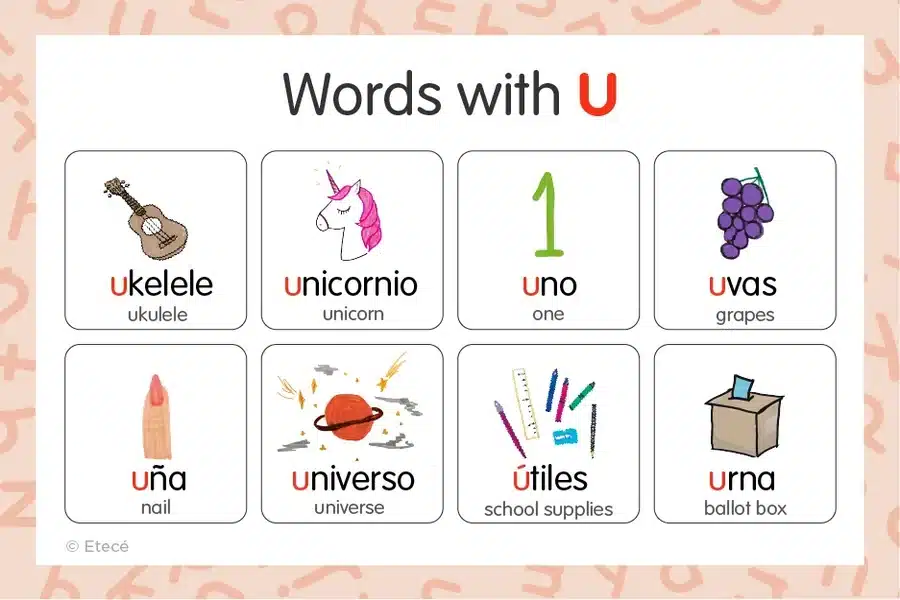
Simple yet strong words form the basis of everyday communication, and numerous words in the Spanish language which begin with u, are used in our daily lives. Words like uno (one), usted (you formal), and ultimo (last) are effective and are always used by the inhabitants of the country. The words are core to learners since the words are used in act of greetings, instructions and other conversations. As an illustration, usted, meaning fancy, is an official way of addressing a person, indicating the Spanish cultural values of respect. With a perfect mastery over these key terms, the learners are therefore in a position to establish a good foundation of effective communication.

Descriptive Adjectives
The use of description makes speech and writing come to life and words in the Spanish language that begin with u also contain assortment of adjectives that add variety to expression. udtil (useful), lastminute (urgent), único (unique): Some words like these are good and can be used both formally and informally. All these adjectives enable the speaker to present details, urgent or stressful situations. As an example, words used to describe something like ‘uno’ are given emotional relevance as the idea is to interpret something unique. Students that train to use descriptive adjectives will find it remains simpler to give their context and writing a touch of color and richness.
Academic and Scientific Usage
Academic and professional settings are mainly Spanish-speaking and some of the words in Spanish that begin with the u sound are of such special fields. Educational, scientific and technical words include words like universidad (university), unidad (unit) and urbano (urban). A good part of these words are of Latin origin and are therefore easier to be identified as learned by English learners. These terms are not only practicable but also critical to the involvement of a student and a professional in an academic discussion or grasping technical literature. The wide range of vocabulary in this category would prove learners to be ready to communicate in classrooms as well as in the workplace.
Cultural and Religious Terms
Culture is closely related to language and there are certain words in Spanish which open with u that depict the religious and cultural beliefs. Such words as union (union) and unidad (unity) usually fall into cultural or religious implications, and they reflect the idea of harmony, community and unity. In most of the Spanish-speaking communities, customs and religion affect the use of simple words, and such words embody the significance of common values. Knowing them, students can develop not only their vocabulary but obtain some understanding of the cultural identity of Spanish-speaking people. These are words which form an international between language and culture.
Emotional and Expressive Language
Communication revolves around feelings and emotions, and a number of words in the Spanish language, which begin with u, enable the speaker to depict feelings and attitudes. Such adjectives like ufano (proud), urgido (pressed or needy) and ultrajado (offended or outraged) indicate the emotional states characterized by intensity. Such expressions can be encountered in literature, films and normal expressions whereby emotions contribute significantly. Studying emotional vocabulary enables the learners to relate more to the native person as they practice learning how to express their feelings and how to read some nuances of emotions effectively. Storytelling and self-expression is also abundant in Spanish with the addition of emotional words.
Read More: How to Stay Stylish and Confident While Managing Alopecia
Idioms and Phrases
The use of idiomatic expressions adds creativity and richness to the language, and even certain idiomatic expressions consist of words that beginning with u in the Spanish language. As an example, ultima hora is very much closer to breaking news in the case of the news; otra y otra vez is close to again and again. These expressions show that some words have a deeper meaning than literature. Language idioms may be difficult to learn yet using them will grant the learning authenticity and fluency in speech. Through endeavored idioms, the student may have a wider understanding of how words work in communication and culture in the real world.
A look at Spanish words beginning with u shows how variable and important such a group of words are. Not only basic words such as uno and usted but also words characterizing something, such as útil and único, these words are necessary at all levels of a learner. They also spill over into an academic, cultural, emotional and idiomatic usage, so, they can useful both a normal household communication as well as an intellectual setting. Knowledge of such words enhances the ability to use language, deepens the character of expression, and also provides the understanding of cultural values. Developing them, the learners open possibilities to understand better how to communicate and respect the Spanish language.
FAQs
1. What are some basic words in Spanish that start with U?
Some common examples include uno (one), usted (you formal), and último (last).
2. Why are words in Spanish that start with U important for learners?
They are frequently used in daily communication, academic discussions, and cultural expressions, making them valuable for fluency.
3. Do words in Spanish that start with U have English similarities?
Yes, many like universidad (university) and unidad (unit) share Latin roots with English, which helps learners recognize them easily.
4. Are there descriptive words in Spanish that start with U?
Yes, words such as útil (useful), urgente (urgent), and único (unique) are commonly used adjectives.
5. How can I practice words in Spanish that start with U effectively?
Learners can use them in sentences, read Spanish texts, and listen to conversations or media where they naturally appear on English Overview.